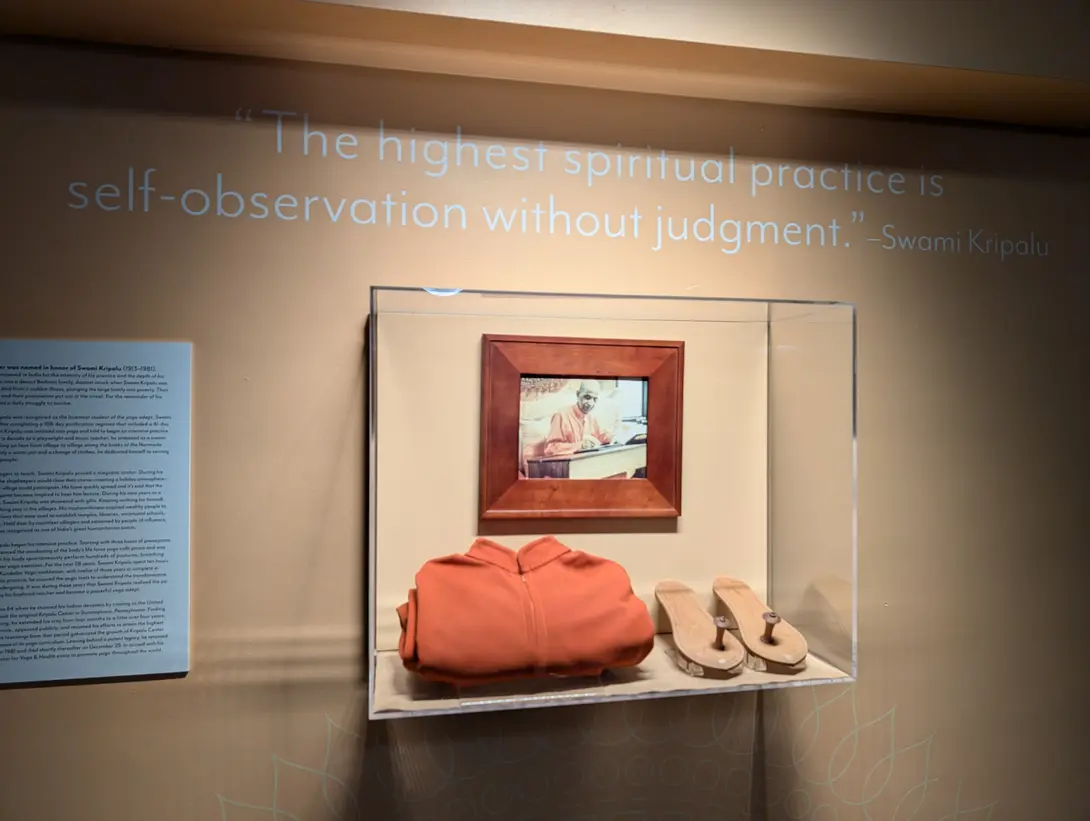
I remember standing in front of the display case outside the elevator on the 3rd floor of the Kripalu Center, reading the quote above it. “The highest spiritual practice is self-observation without judgment.” Below the words, in a glass case, was Swami Kripalu’s neatly folded orange robe and a pair of wooden sandals. The fabric looked nice and thick, probably handmade, and not like the kind I’d seen in fabric stores. Above the clothes, there was a photo of him at a writing desk, pen in hand.
If you walk the halls at Kripalu, you’ll likely encounter that same sentence more than once, on placards and posters taped to doors, but with no case, robe, or sandals. Those look like the kind of inspirational quotes to post on a college dorm wall or social media.
I’ve also heard this quote repeated countless times by yoga teachers over the years, and, honestly, it often feels like a relief. It offers permission to relax and just watch. Don’t fix, don’t judge, and don’t perform a better version of yourself. But at the Kripalu Center, standing in front of his actual clothes, that sentence landed differently.
This wasn’t a man who sat back and let his mind wander wherever it wanted.
The text panel next to the case provides more background information about the quote. Swami Kripalu started his intensive practice with three hours of pranayama a day. Over the next twenty-eight years he practiced and meditated ten hours a day, twelve of those years in silence. That’s some serious dedication. In his life, “self-observation without judgment” belonged within a demanding discipline sustained for decades.
So what role does non-judgment play in a life shaped by that much effort?
The Three Stages
Some people read “self-observation without judgment” as the reward waiting at the top of a ladder, something you reach only after climbing through the Three Stages of Kripalu Yoga, as if you could climb up once and ring the bell at the top having reached your goal. But that’s not how Swami Kripalu taught it. Non-judgment isn’t parked at the finish line. It plays a role in each of the three stages, and together the three stages are how you keep energy (prana) and awareness (chitta) in balance, rather than favoring one over the other. The practice is learning what kind of balance any given moment calls for.
Stage one is about getting the body, breath, and mind working together. This stage is willful. You practice alignment, coordinate breath and movement, you pay close attention to what your body is doing. Like learning any new skill, it requires effort and can feel disorienting. As you stretch and strengthen, it’s easy to get self-critical, caught up in thoughts like “am I doing this right?” or “does my pose look like the picture?” “Without judgment” at this stage means keeping close watch on the natural human tendency towards self-criticism, while not skipping the work of experimenting and learning.
Stage two is where you start to stay with a pranayama (breath) practice or asana (pose) longer, holding it past the point of comfort. At that point, judgments, stories, and doubts can start to appear in the mind, sometimes before the body needs a break. Your mind might be screaming “YOU CAN’T DO THIS ANY LONGER!” Non-judgment is key here, too, because it’s tempting to either push through and ignore those thoughts, or judge yourself for having them in the first place. Rather, you watch closely enough to distinguish resistance from a genuine need to stop or change course. This stage is about opening the heart and clearing the mind, blending will and surrender.
Stage three is where the letting go happens. Movement arises on its own, without you steering the ship. Swami Kripalu called this “meditation in motion.” But full surrender is only possible when your mind and body are ready. Stage three arises when the energy calls for it, not because you pushed through the previous two stages.
The Robe in the Hallway
Back in the Kripalu Center, I walked past that orange robe multiple times a day because my room was just down the hall. In some sense, it was just another piece of fabric with a zipper. Yet it belonged to someone who spent ten hours a day practicing, without treating effort as something to transcend.
So when I use this phrase now in a class or in my own practice, I try to remember that observation is only one aspect of the practice. Non-judgment isn’t a substitute for effort. Instead, it helps prevent the effort from becoming another way to beat yourself up.
Next time you catch yourself thinking “just observe, no judgment,” ask whether non-judgment is clearing space for awareness or giving you an excuse to avoid something that needs attention. Yoga has a word for that kind of discernment, viveka, and it’s part of the practice, not opposed to it. So if that phrase, or one like it, pops into your mind while you are holding a pose or having a conversation, notice your thoughts without automatically believing them, and keep listening to your body. Notice what another breath, another round, or a pause reveals. Let that experience inform your response.
Comments