As the Theravada Buddhist monk Thānissaro Bhikkhu observed recently, “ill will seems to be in fashion.” The world is watching in horror as people here in Minnesota are harassed and shot. Many people I’ve talked to are on edge. We are doing our best not to “take the bait,” but tensions are high. Many of us want to respond, and when we do, it’s easy to wonder whether our individual actions really matter.
Watching the Walk
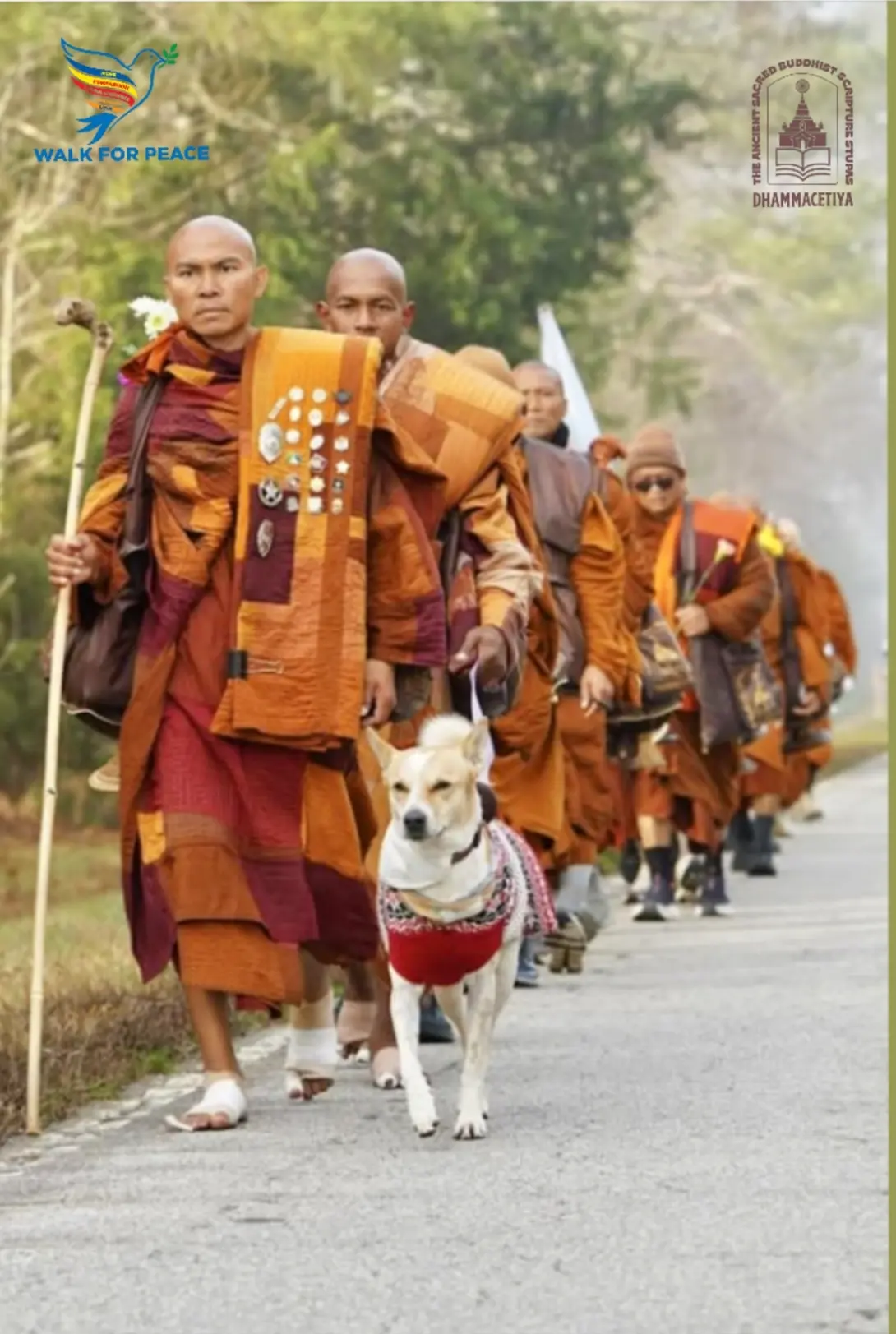
At the same time, much of the world has been drawn to a very different event. A small group of Theravada Buddhist monks is walking more than 2,300 miles, from Texas to Washington, D.C., to share a message of peace, loving-kindness, and compassion.
These monks are not selling merchandise, products, or services. They are simply walking, day after day, with presence, intention, and care.
They don’t seem to have catchy slogans or any grand statement. They are just walking for peace. They promote lasting change that grows from small acts of goodwill, like sharing a flower. This stands in stark contrast to the force and outrage the current administration seems eager to create.
Peace can feel distant or abstract. Yet these monks remind us that it starts right here, in our own bodies, homes, and communities.
As the monks explain their motivation, “Everything that has ever mattered began with something impossibly small. A single seed. A first mindful breath. A quiet decision to take one step, then another.”
We don’t transform our lives in one big moment. We show up again and again, step after step, choosing awareness over reactivity and kindness over hatred.
A Long Tradition of Walking
The Walk for Peace draws from a monastic tradition known as tudong: the Thai form of the Pali word dhutanga, which refers to austere practices meant to “shake off” habits, attachments, and delusions. In this tradition, walking is not about arriving somewhere. Rather, it’s a form of training. The simplicity and uncertainty of life on the road become supports for mindfulness and insight.
Ajahn Amaro, another Theravada Buddhist monk and one of my most influential teachers, wrote about his own tudong walk across England in 1983 in his book, Tudong: The Long Road North. He was the only monk on the walk, accompanied by a single lay companion, Nick Scott. It was “not to be a quest for fame or identity.” The physical challenges of the journey became objects of contemplation, pointing back to the insight that, as he puts it, “there is nobody going anywhere.”
The Walk for Peace shares these roots while expressing them differently. Their tudong is collective and highly visible. The walkforpeace.usa Instagram account currently has 1.3 million followers. Their journey is a public teaching, offered as a way of letting inner cultivation extend outward into shared space and civic life. The leader of the Walk for Peace walks barefoot to feel the ground and promote mindfulness. Some of the monks have taken on more extreme dhutanga vows, including never lying down. (Incidentally, Ajahn Amaro did the practice of not lying down for about three years, but not on his walk.)
From Inner Peace to World Peace
The Walk for Peace reminds us that peace is not imposed. It grows from the inside out. As we cultivate steadiness and kindness within, our external relationships can change, and sometimes our communities change, too.
Their walk is not about converting people to Buddhism or promoting a belief system. It’s a reminder to live with less harm and more compassion. In a time when fear, force, and dehumanization are increasingly normalized in public life, visible reminders like this feel especially necessary.
One of the stated goals of the Walk for Peace is to promote loving-kindness, metta, which Thānissaro Bhikkhu translates as “goodwill.” In that sense, this walk is an antidote to ill will. My hope is that watching these monks walk inspires us to practice more goodwill. When more people choose to live with goodwill, the world becomes a better place for everyone.
For more details on their journey and how you can support the monks, visit the Walk for Peace website.
Comments