(This article was originally published on Drupal.org.)
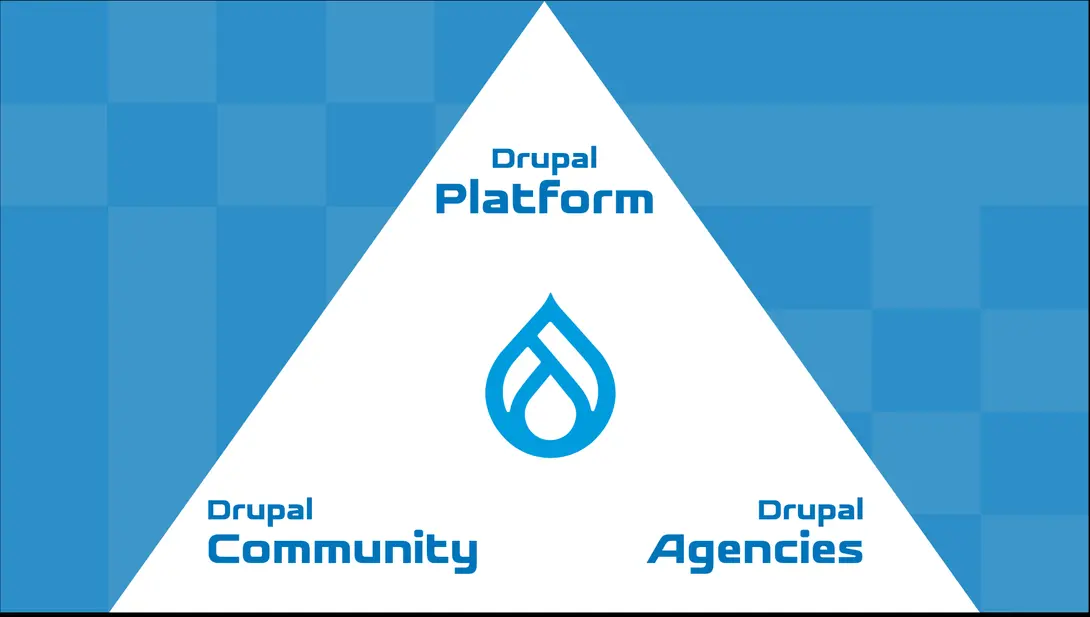
At DrupalCon Chicago, the Driesnote included a visualization with “community” as one of the three pillars of Drupal, along with “platform” and “agencies.” That framing felt memorable, and worth exploring further.
If you attended DrupalCon Chicago, you might have experienced a slightly differently shaped triangle. I don’t know the attendance numbers, but I saw technical sessions with packed rooms, while community-focused sessions had plenty of empty seats. That’s not new. It’s been true for years. People care about community, but when the schedule forces a choice between a session on AI integration and one on community health, most folks choose the technical session. I understand why. Technical work feels concrete. Community work is generally not why employers send folks to a DrupalCon.
This raises a question: how can all of us work together to close that gap without having to attend community sessions at DrupalCon?
Consulting our Code of Conduct
I serve on the Community Working Group (CWG), specifically on the Community Health Team. A lot of people don’t know there are two teams inside the CWG, so here’s the short version:
- The Conflict Resolution Team handles incidents after they happen. If you file an incident report, they’re the ones who review it.
- The Community Health Team works on everything that happens before an incident report, such as workshops, resources, and other preventive work. Our goal is to help the community build the kind of culture where fewer situations reach the reporting stage in the first place.
Both teams matter. And beyond the CWG, the DrupalCon Code of Conduct offers advice for all of us. It includes a section titled “We are collaborative,” which says:
If and when misunderstandings occur, we encourage people to work things out between themselves where this is practical. Where support is beneficial to achieve this, participants agree to ask for help. People are encouraged to take responsibility for their words and actions and listen to constructively-presented criticism with an open mind, courtesy, and respect.
I suspect that many people read the harassment list and the reporting email and stop there. That’s understandable. Those parts exist for a reason. But the passage above describes the wide middle ground where most friction in our community occurs.
The Middle Ground of Community Health
If the only two options we envision are “this is fine” and “file a report,” we end up with a lot of buried resentment, a few dramatic blowups, and not much in between. Most day-to-day friction doesn’t rise to the level of a Code of Conduct violation. It’s tone. Assumption. Misread intent. A comment in an issue queue from someone who didn’t scroll up to read what had already been said. A joke that came off differently than it was intended.
The Community Health Team’s work is to strengthen the middle. That means helping people develop the habits and skills to address friction directly, kindly, and early, so it doesn’t compound into something that needs the Conflict Resolution Team. The Code of Conduct invites everyone to do this work. Not just CWG members. Everyone.
Some Ways We Work Things Out
Here are four situations I’ve seen in the community, and in some cases been part of. None of these are scripts. They’re illustrations. The point is that the Code of Conduct invites you to try, and that you’re allowed to. You don’t need permission.
- Late at night at a DrupalCon, after hours of sprinting and drinks in the hotel lobby, someone says something about another contributor that turns a few heads. That person might realize it the next day. The generous move, the one the Code asks for, is to find that person and say “I said something last night I want to walk back.” Not a grand apology. Just a small, honest correction. Most of the time, that’s the whole fix.
- Someone drops a comment in an issue queue without reading the full thread above. Their comment reads as dismissive of work that’s already been done, or repeats a point that was already addressed, and it comes off as rude. They might not know that’s how it came across. A direct message from someone in the thread (“hey, I think you may have missed a few comments, here’s where we landed”) can turn that into nothing. A pile-on in the issue turns it into something else.
- You witness an exchange between two people at DrupalCon that makes you wince. Maybe it’s cultural. The Drupal community spans continents, and directness that comes across as rude in one country seems normal in another. Maybe it’s a power dynamic, or a bad day, or both. Checking in with the person on the receiving end, just between the two of you (“I could not help but notice your conversation and I wanted to ask, are you doing okay?”), doesn’t escalate anything. It lets them know they weren’t invisible.
- Someone keeps doing something that just doesn’t feel right. Not harmful, but grating. You can do your best to describe how it made you feel before it becomes a grudge you carry into every future interaction. “Hey, can I mention something? The way we’re doing X did not sit well with me, and I want to figure out how to talk about it.”
If you need help figuring out the best way to handle a situation like this, the Community Health Team is available. We can help you talk through a situation, decide whether a direct conversation is possible, or offer a second perspective. You can reach out at any time. We don’t investigate, and we don’t take sides. We think with you.
When It Isn’t Practical
The Code says “where this is practical.” Sometimes it isn’t.
We live in a world with power differences. If the person on the other side holds significant authority over your ability to contribute, a direct conversation may not be safe for you. Ongoing patterns of behavior are different from single incidents. Safety concerns are different from style concerns. And if the other person has shown they aren’t willing to engage in good faith, you are not obligated to keep trying.
Those are incidents for the Conflict Resolution Team. Those are the situations the people on that team signed up for, and you can reach them through the incident report form. Filing a report is not escalation for its own sake. It’s using the right tool for the situation.
The Three-pillar Framing
Returning to the Driesnote, if community is one of three pillars holding up Drupal, then the pillar can’t only be carried by the folks who show up to CWG sessions. The math doesn’t work. Community health has to happen in the rooms with the technical sessions, on the Slack channels where the code review happens, or at the dinner table where someone just got interrupted for the third time.
Most of the work the Community Health Team cares about isn’t work you need a whole session to learn. It’s work you’re already in a position to do. The next time something said in an issue queue doesn’t feel right, you catch yourself venting about someone, or you see a newcomer get talked over, you have a chance to support Drupal’s community.
Community is a pillar, which means it doesn’t get held up by a small group of people with CWG in their session title. It gets held up, or it doesn’t, by how we talk to each other on a Tuesday afternoon when no one’s watching.
Drupal’s Code of Conduct doesn’t just give you a way to report harm. It also asks you to do the smaller, harder thing first. That’s where most community health happens.
Comments